
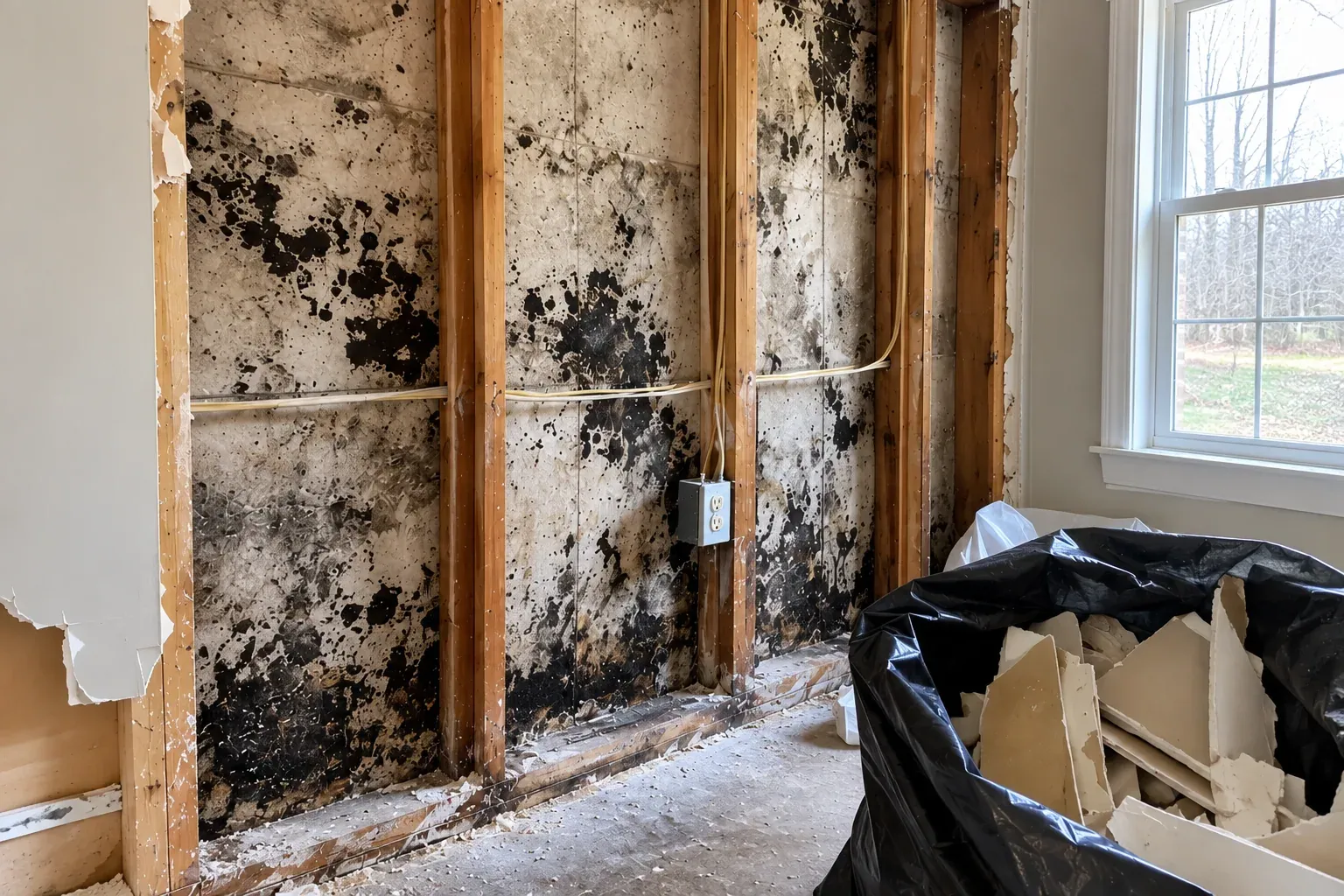
Mold Removal and Remediation
You pulled the couch away from the wall and found black stuff growing up the drywall. Or the carpet came up and there's green fuzz across the pad. Here's what happens next.
The job, step by step
Every mold job we do follows the same arc. It’s the ANSI/IICRC S520 standard, and it’s also just what works.
1. Find the water. Nothing gets scoped until we know why the mold started. A leaking supply line, a bath fan dumping into the attic, a stone wall sweating every July, a sump pump that quit. If the cause isn’t fixed, the rest is temporary.
2. Contain the area. Six-mil plastic, zipper doors, HVAC vents sealed. For anything over about 100 square feet we run full containment under negative air pressure, which means a HEPA machine is pulling air out of the work zone so spores can’t drift into the rest of the house.
3. Remove what’s grown on. Drywall, insulation, carpet and pad, ceiling tile. Porous material with growth on it comes out and leaves in sealed bags. This is the heart of the job. Spraying it and closing it up isn’t remediation.
4. Clean what stays. Framing, sheathing, block, and subfloor get HEPA-vacuumed and damp-wiped. Heavy staining on wood gets wire-brushed, sanded, or media-blasted. Then an antimicrobial treatment, as a supplement to the removal, never a substitute.
5. Dry it to standard. Commercial dehumidifiers and air movers until the framing reads dry on the meter. We log the readings. This is the step rushed jobs skip, and it’s why they come back.
6. Check it. Visual inspection, no musty odor, dry moisture readings. If you want an independent clearance test before containment comes down, we’ll schedule around it.
7. Put it back. Drywall patched, floor replaced, paint on. You get a room, not a construction site.
What “done” means to us
A job is done when the framing is dry and treated, not when the walls are back up. Those are different days.
Chuck learned this running water jobs for a national restoration franchise before he started this company. Crews were measured on speed. Walls went up over studs that were still damp, and six months later the homeowner called somebody else. A good part of our work now is redoing those jobs. We’d rather do yours once.
What affects the price
Most typical remediation jobs in this area land between $1,500 and $6,000. Small contained jobs under 10 square feet run about $500 to $1,500. A finished basement with growth across several rooms after a flood is a different animal, often $10,000 to $30,000 or more.
Where yours falls depends on:
- Size of the affected area and how far it has spread
- What has to come out. Drywall and carpet cost more than a hard surface wipe-down
- Access. Attics, crawl spaces, and behind cabinets take longer
- Containment level. Limited for 10 to 100 square feet, full negative-air for larger areas
- Category of water. Clean supply line water is one thing. Sewage or gray water means more material removed and more protection
- How long it sat. Wet materials start growing mold in 24 to 48 hours. A leak found in a week is a small job. A leak found after three years behind a dishwasher is not
The number you can count on comes after the inspection, in writing, before work starts.
Staying in the house
Most families stay home during the work. The containment and the negative air keep spores in the work zone, and we keep the paths to it clean. If anyone in the house has asthma, a weakened immune system, or is very young or elderly, tell us. We’ll talk through whether a few days elsewhere makes sense, and your doctor should be part of that conversation.
Contents
Belongings in the work area get sorted. Hard goods usually clean up fine with a HEPA vacuum and a wipe-down. Soft porous items that have growth on them, like a couch that was against the wet wall, usually don’t survive. We’ll tell you what’s salvageable before we start, not after.
The standard behind the work
We hold the IICRC AMRT certification and follow the S520 standard, which sets three conditions for a space. Condition 3 is active growth. Condition 2 is settled spores from that growth. Condition 1 is normal. The goal of remediation is getting your house back to Condition 1, not to sterile. Every house has spores in it. What a healthy house doesn’t have is growth, a musty smell, or wet framing.
If you’re not sure what you’ve got yet, start with a mold inspection and air quality test. If the water is still coming in, water damage and structural drying comes first. And if you want to know who’s showing up, Chuck’s story is on the home page.
Our services
Frequently Asked Questions About Mold Remediation
What's The Difference Between Mold Removal And Mold Remediation?
Removal is taking out the moldy material. Remediation is removal plus fixing the conditions that grew it, cleaning the air and surfaces, drying everything to standard, and verifying it's back to normal. Anyone can remove. Remediation is the whole job.
Can't You Just Fog or Spray it Instead of Tearing Out Drywall?
Fogging, ozone, and spray-only treatments are sold as no-demolition fixes. The S520-2024 standard treats them as outside the standard of care when used instead of physical removal. Dead spores still cause reactions, and a fogger doesn't dry a wet stud. We use antimicrobials as a supplement after removal, not as the job.
What Does The Warranty Cover?
Every residential job carries a 1-year warranty on our work. Commercial and insurance-mandated jobs carry 2 to 5 years depending on the scope. The warranty covers the remediation we performed. It doesn't cover a new leak, a new flood, or a moisture source you chose not to fix.
Do You do The Drywall And Paint Afterward?
Yes, for the light repairs that come with a remediation job: drywall patching, replacing a section of floor, painting. Bigger rebuilds, like a whole finished basement or structural framing, we coordinate with trades we've worked with for years. We'll be upfront about which is which.
Do You Handle Insurance Claims?
We document the job for your claim: photos, moisture readings, the written scope, and the invoice. Your adjuster gets what they need. We don't negotiate claims or promise coverage. Most policies only cover mold from sudden events like a burst pipe, and often cap it at $1,000 to $10,000.
Find the Water. Remove the Mold. Get Your Home Back.
(267) 828-9088Request an inspection- Started in Gettysburg in 2012
- IICRC AMRT and WRT certified
- 1-year warranty on every job
- Chuck is on the job, not just the phone