
Basement and Crawl Space Mold Removal in Gettysburg, PA
Every summer the basement smells like a damp cave. There's white powder on the block wall and dark fuzz on the boxes. This is the most common call we get, and Adams County's housing stock is why.
Why basements here grow mold
South central Pennsylvania has some of the oldest housing in the country. Around Gettysburg that means fieldstone and rubble foundations from the 1800s, early block from the 1920s through the 50s, and a lot of 1960s and 70s split-levels with basement garages. Almost every house has a basement. Very few of the old ones were built to be dry.
Stone and old block wick moisture. When humid summer air hits a foundation wall that’s sitting at ground temperature, it condenses. That’s why the basement smells fine in February and like a damp cave in July, and why the fuzz shows up on stored boxes, the back of the workbench, and the bottom two feet of the drywall in a finished room.
Add a sump pump that quits in a spring storm, gutters that dump against the foundation, or a slow leak from the water heater, and you’ve got the three ways every Adams County basement ends up on our schedule.
What we look for first
The mold is the easy part to find. The moisture source is the job.
- Grading and gutters. Does water run toward the house or away from it? Are the downspouts extended? This fixes more basements than any product.
- Humidity. We read it at several spots. Above 60% and spores will grow on almost anything. The target is 30 to 50.
- Sump and drainage. Is there a pump, does it run, is there a battery backup, where does it discharge.
- Condensation points. Cold water lines, uninsulated ducts, the north wall. Sweating surfaces feed growth on whatever’s below them.
- Finished basement construction. Carpet on a slab with no vapor barrier and drywall tight against a stone wall is a mold sandwich. We check behind it with a meter before anyone opens it up.
The remediation
Basement jobs follow the same S520 process as everything else: containment, negative air, remove porous material with growth, HEPA-clean and treat the framing and masonry, dry to standard, verify, then repair. A few things are specific to below-grade work:
Stone and block walls get cleaned and treated, not replaced. Heavy staining on masonry comes off with brushing or blasting.
Finished basements usually mean the bottom two to four feet of drywall come out along the wet walls, plus any carpet and pad that got wet. We cut clean lines so the repair is a straight patch.
Stored contents are where a lot of the growth lives. Cardboard boxes on a damp floor are a mold buffet. We’ll sort what’s worth cleaning and what isn’t.
Crawl spaces
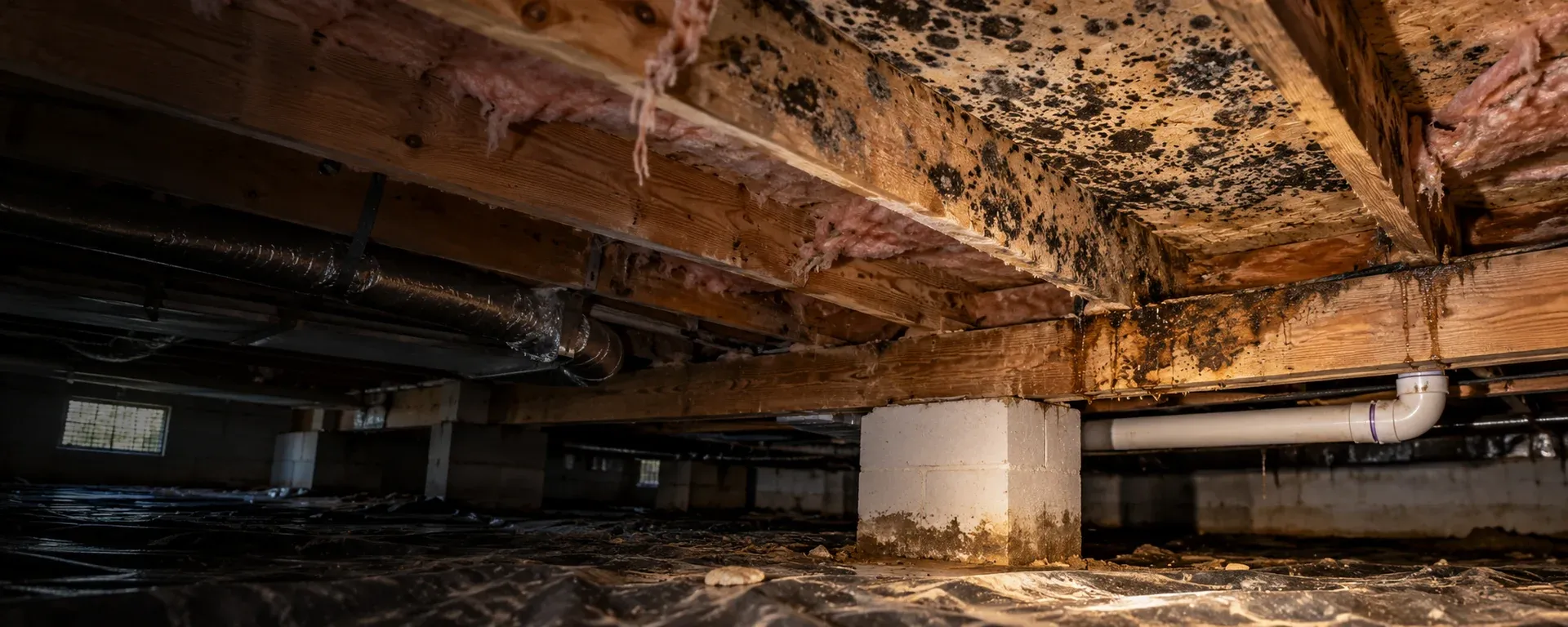
Farmhouses, additions, and the mountain homes out toward Carroll Valley often sit on crawl spaces instead of full basements. A dirt floor with no vapor barrier puts gallons of ground moisture into the air under your house every day, and the floor joists above it are wood. That’s where the growth shows up, usually as white or gray fuzz along the joists and subfloor.
Crawl space remediation means getting in there and cleaning every joist, treating the wood, and then dealing with the ground moisture with a vapor barrier or a full encapsulation. Tight access is what drives the cost. A crawl space you can crouch in is a different job from one you have to belly-crawl.
What it costs
Typical basement mold jobs in this area run about $500 to $3,000. A full finished basement with growth on several walls can reach $15,000, and a flooded finished basement with growth everywhere is $10,000 to $30,000 or more. Crawl spaces run about $500 to $2,000, higher when access is tight.
The drivers: how much wall area is affected, whether it’s finished, how much drywall and flooring has to come out, access, and what it takes to fix the moisture source. Related costs homeowners often bundle in are a properly sized dehumidifier, a sump pump with backup, and, for crawl spaces, encapsulation.
Every job is different and the real number comes after an inspection, in writing.
After the job
The basement stays fixed if the moisture stays controlled. That means the dehumidifier runs, the gutters stay clean, the sump works, and nobody stores wet cardboard against the stone wall. We’ll leave you with a short list. If the problem started as standing water, read the water damage and structural drying page for what to do in the first 48 hours. If you’re not sure whether what you’re seeing is mold, a mold inspection settles it. And the home page covers who we are.
Our services
Frequently Asked Questions About Basement & Crawl Space
Is The White Stuff on my Block Wall Mold?
Usually not. White, powdery, crystalline deposits on block or stone are efflorescence, mineral salts left behind as water moves through the masonry. It's not mold, but it is proof water is moving through the wall, which means the humidity in that basement needs attention. Fuzzy white growth on wood is a different story.
Should I Paint The Basement Walls With Waterproofing Paint?
Be careful with that on stone and old block. Coating the inside of a foundation that wicks moisture can trap water inside the wall and make it worse. Manage water outside with grading and gutters, and manage humidity inside with a dehumidifier. If the wall needs sealing, it's usually an outside job.
Will a Dehumidifier Fix it?
A properly sized one prevents it. It doesn't remove growth that's already there. Get the existing mold handled, then keep the basement under 50% humidity and it stays handled. A small unit from the hardware store in a big stone basement won't keep up.
What is Crawl Space Encapsulation, And do I Need it?
Sealing the dirt floor and walls with a heavy vapor barrier, closing the vents, and usually adding a dehumidifier so the crawl space stays dry year-round. Not every crawl space needs it. If yours has a dirt floor, no vapor barrier, and mold on the joists, it's worth pricing after the remediation.
Find the Water. Remove the Mold. Get Your Home Back.
(267) 828-9088Request an inspection- Started in Gettysburg in 2012
- IICRC AMRT and WRT certified
- 1-year warranty on every job
- Chuck is on the job, not just the phone